Everything Is Photograph offers a sweeping and intimate portrait of André Kertész, tracing the life and work of a man whose vision helped define modern photography. Born in Budapest in 1894, Kertész’s journey carried him from the cafés of Jazz Age Paris to the bustling streets of wartime New York, through periods of acclaim, obscurity, and reinvention. This biography presents a detailed exploration of both his personal and professional life, revealing the hardships, triumphs, and enduring curiosity that shaped his art.
Kertész was a pioneer in embracing new technologies and approaches. He was among the first to see the potential of the Leica camera, forever linking the instrument to street photography, and he helped establish the language of subjective photojournalism, producing one of the earliest influential photo essays. Over his career, he captured more than 100,000 images, each marked by a distinctive combination of formal rigor, emotional depth, and subtle humor. His work explores human connection, self-expression, and the mysteries embedded in everyday life, making ordinary moments resonate with extraordinary clarity.
The biography delves into Kertész’s complex personal history, from the traumas of World War I to the shadow of the Holocaust, and from tangled romances to professional rivalries with contemporaries like Brassaï and mentorship of figures like Robert Capa. It illuminates the resilience and adaptability that allowed him to navigate both the glamour and the hardships of the photographic world, including his years working for House & Garden and his later resurgence during the 1960s photo boom.
Through archival research and interviews, the book brings Kertész vividly to life: a man of Old-World charm, occasional mischief, and profound artistic insight. Everything Is Photograph is not only a biography but a meditation on photography itself — a medium capable of narrating identity, exploring perception, and connecting people across time and place. It immerses readers in the aesthetics, culture, and humanism of a lost photographic era, while celebrating the enduring influence of one of the medium’s most innovative and generous visionaries.
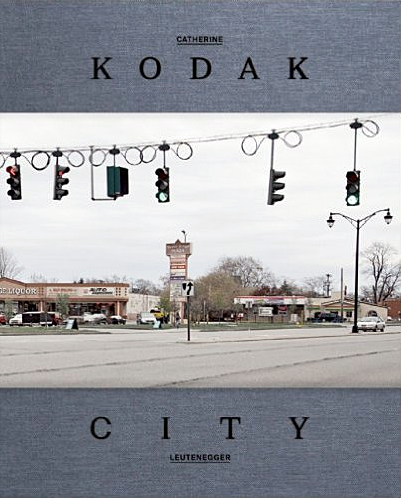
Eastman Kodak, the company which pioneered so much in photography from the 1880s through the 1960s, could have owned digital imaging; the very first electronic camera was born in one of Kodak's labs. Instead, they missed that boat, going into a tailspin that resulted in their eventual bankruptcy. Tied to that economic engine, the fortunes of Rochester, New York, the archetypal company town where Kodak had its headquarters, fell as "Big Yellow" collapsed. Catherine Leutenegger's attentive, deadpan studies of Rochester today explore the face of a city once central to photography but now irrelevant and adrift.
In October, when we were down in Bristol for the Foundation’s BOP event, Martin, Caroline and I got together to select the edit for this new 2026 edition of Small World.
It had become almost a tradition that with every reprint of the book we would change the cover and add in a number of new photos that Martin had rediscovered or taken recently. Over the years, Martin and I made six different editions of the book – each subtly different and each with a new cover. For this edition we added in eight new images, five taken in 2025 and three earlier images. Back in Stockport over the following weeks I adjusted the sequence to accommodate these new images, sent it over to Martin for his approval and then sent it off to EBS, our printers in Italy.
SNAP COLLECTIVE presents the first book by photographer Asako Naruto, who has received numerous international awards. Through her lens, the artist explores the contours of “what is present” while
tracing the silent echoes of “what is absent.” Divided into ten chapters, the
book gathers fragments of “untold stories” that float through the streets of
Madrid, reflecting the fleeting nature of memory and the delicate fragility of
existence.
Anna Atkins: Photographer, Naturalist, Innovator offers a clear and well-documented introduction to one of the most important yet long-overlooked figures in photographic history. Corey Keller places Atkins’s cyanotypes within their scientific, technical, and social context, showing how her work contributed to the early development of photographic publishing while navigating the constraints faced by women in the nineteenth century. Concise, carefully illustrated, and accessible to non-specialists, the book provides both visual pleasure and historical insight. It is an essential reference for readers interested in early photography, photobooks, and the intersection of science and image-making.
Archipelago, a debut photobook by Yolanda del Amo, explores the tension between the inner and exterior realities of human life. Through staged tableaus featuring friends and family, Del Amo constructs moments that expose the social frameworks shaping identity, class, family, and gender. Her photographs illustrate how closeness and separation coexist within the same space and reveal the fragile balance between connection and solitude.
Photographed in London, Near Dark ventures into a mysterious territory, reflecting a less harmonious city mood, a fever dream of anxiety and unpredictability. London is just as alluring as ever but now everyone is taking shelter, keeping out of sight.
I constantly wonder where I truly belong. This series explores the psychological impact of
relocation and emigration that I have experienced throughout my life. The title is inspired by the
keyboard shortcut I frequently use when typing in Japanese, and it serves as an indirect
representation of my national background.
Agony in the Garden is the second monograph by Magnum Photographer, Lúa Ribeira, created
in her native country of Spain between 2021 to 2023 in the peripheries of Madrid, Málaga,
Granada and Almería. Inspired by the revealing potential of contemporary counter-culture,
she has collaborated with young people to make images that reflect on the alienation and
uncertainty of the present era, evoking a dystopian landscape suspended in time, one that
appears both contemporary and ancient while reflecting the signs of contemporary youth
movements and how they convey the alienation and uncertainty of the present-era
This series of black-and-white portraits depicts the people around whom Denis Dailleux grew up, between love and hate. Created when he was 25 years old and full of doubt, the project marked a turning point in the photographer’s work.
Anastasia Samoylova’s Atlantic Coast is more than a photography book—it is a journey through the evolving landscape of the United States, both literal and metaphorical. Retracing U.S. Route 1 from Key West, Florida, to Fort Kent, Maine, seventy years after Berenice Abbott first documented the road, Samoylova offers a meditation on the tensions between nostalgia and progress, myth and reality, that define the American experience.