All about photo.com: photo contests, photography exhibitions, galleries, photographers, books, schools and venues.
Win the First Solo Exhibition of 2026! Submit your best project now. Open Theme
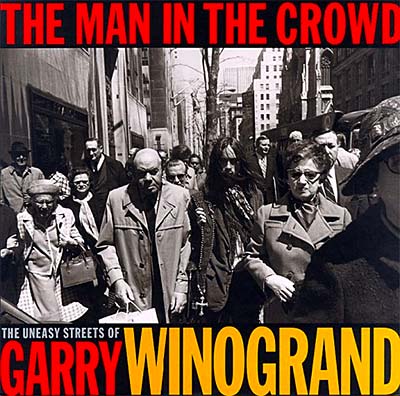
Garry Winogrand
Garry Winogrand

Garry Winogrand

Country: United States
Birth: 1928 | Death: 1984

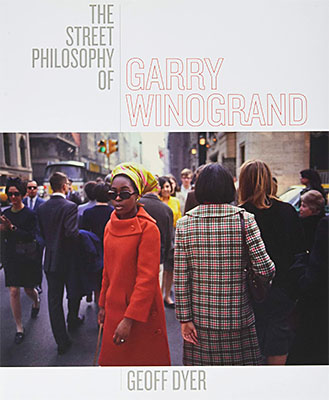
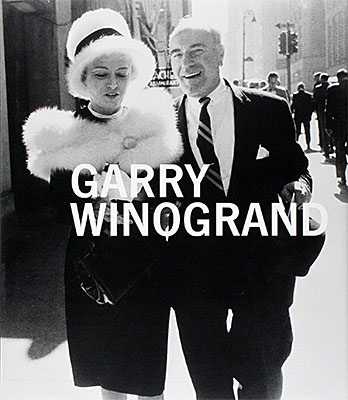
Garry Winogrand was an American street photographer, known for his portrayal of U.S. life and its social issues, in the mid-20th century. Photography curator, historian, and critic John Szarkowski called Winogrand the central photographer of his generation. Winogrand was influenced by Walker Evans and Robert Frank and their respective publications American Photographs and The Americans. Henri Cartier-Bresson was another influence although stylistically different.

Winogrand worked as a freelance photojournalist and advertising photographer in the 1950s and 1960s. Between 1952 and 1954 he freelanced with the PIX Publishing agency in Manhattan on an introduction from Ed Feingersh, and from 1954 at Brackman Associates.

Winogrand's beach scene of a man playfully lifting a woman above the waves appeared in the 1955 The Family of Man exhibition at the Museum of Modern Art in New York which then toured the world to be seen by 9 million visitors. His first solo show was held at Image Gallery in New York in 1959. His first notable exhibition was in Five Unrelated Photographers in 1963, also at MoMA in New York, along with Minor White, George Krause, Jerome Liebling, and Ken Heyman.

Winogrand was known for his portrayal of American life in the early 1960s. Many of his photographs depict the social issues of his time and in the role of media in shaping attitudes. He roamed the streets of New York with his 35mm Leica camera rapidly taking photographs using a prefocused wide angle lens. His pictures frequently appeared as if they were driven by the energy of the events he was witnessing. Winogrand's photographs of the Bronx Zoo and the Coney Island Aquarium made up his first book The Animals (1969), a collection of pictures that observes the connections between humans and animals.

He received three Guggenheim Fellowships to work on personal projects, a fellowship from the National Endowment for the Arts, and published four books during his lifetime. He was one of three photographers featured in the influential New Documents exhibition at Museum of Modern Art in New York in 1967 and had solo exhibitions there in 1969, 1977, and 1988. He supported himself by working as a freelance photojournalist and advertising photographer in the 1950s and 1960s, and taught photography in the 1970s. His photographs featured in photography magazines including Popular Photography, Eros, Contemporary Photographer, and Photography Annual.

Critic Sean O'Hagan wrote in 2014 that in "the 1960s and 70s, he defined street photography as an attitude as well as a style – and it has laboured in his shadow ever since, so definitive are his photographs of New York"; and in 2010 that though he photographed elsewhere, "Winogrand was essentially a New York photographer: frenetic, in-your-face, arty despite himself." Phil Coomes, writing for BBC News in 2013, said "For those of us interested in street photography there are a few names that stand out and one of those is Garry Winogrand, whose pictures of New York in the 1960s are a photographic lesson in every frame."

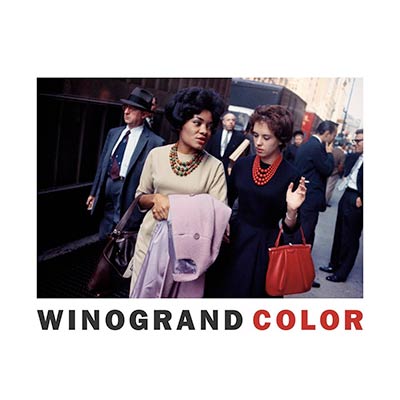
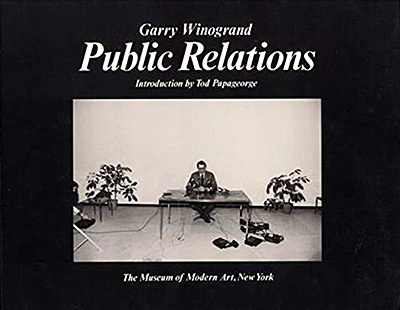
In his lifetime Winogrand published four monographs: The Animals (1969), Women are Beautiful (1975), Public Relations (1977) and Stock Photographs: The Fort Worth Fat Stock Show and Rodeo (1980). At the time of his death, his late work remained undeveloped, with about 2,500 rolls of undeveloped film, 6,500 rolls of developed but not proofed exposures, and about 3,000 rolls only realized as far as contact sheets being made.

Source: Wikipedia


Photography is not about the thing photographed. It is about how that thing looks photographed.

-- Garry Winogrand


A native New Yorker, Garry Winogrand became known for his street photography blending documentary and photojournalist styles and freezing his subjects in spontaneous and bizarre moments. Winogrand typically used a wide-angle lens mounted on a Leica 35mm camera and photographed prolifically, leaving 2,500 rolls of shot but undeveloped film and 300,000 unedited images upon his death. The tilted horizon and feeling of chaos in his images belie his careful compositions concerned with capturing surface detail and energy. Winogrand believed that the act of framing and photographing something transformed it. His images are often confrontational and take moments out of context, positioning Winogrand as an outside observer of human gestures and actions.

Among Winogrand’s favorite subjects were women, and he described himself as being “compulsively interested in women” and having “compulsively photographed women.” A large part of Winogrand’s images in the collection of the MoCP form part of the Women are Beautiful portfolio (1981), which was initially published as a monograph in 1975. For the monograph, John Szarkowski, curator of photography at the Museum of Modern Art in New York at the time, selected eighty-five images featuring women from hundreds of photographs by Winogrand.

The resulting book offers a random collection of women caught on the street, in parks, getting into cars, at parties, marching in parades, skinny-dipping in ponds, etc. The images capture not only Winogrand’s attraction to the women he photographed, but also the styles, activities, gestures, and energies pertaining to gender in the 1960s and 1970s, an era of transition during second-wave feminism and the sexual revolution. In the monograph and in the portfolio, Winogrand wrote: “Whenever I’ve seen an attractive woman, I’ve done my best to photograph her. I don’t know if all the women in the photographs are beautiful, but I do know that the women are beautiful in the photographs.”

Source: Museum of Contemporary Photography



Selected Books

Inspiring Portfolios

Call for Entries
All About Photo Awards 2026
$5,000 Cash Prizes! Juror: Steve McCurry
 
Stay up-to-date  with call for entries, deadlines and other news about exhibitions, galleries, publications, & special events.

More Great Photographers To Discover

Alexis Pichot
France
1980
In 2011, I made the bold decision to redirect my professional life into my self-guided passion, photography. I worked as an interior designer in Paris for more than ten years. Throughout that time I was very focused on the use of space and acquired a sensitivity that has greatly influenced my approach to volume in photography. At night, light and space are my sources of inspiration, experimentation and confrontation - but above all, of fulfilment. I pierce the night using physical movement, as well as using light in order to see beyond what is visible, to a place where the blackness has not yet absorbed everything. I have accomplished various large-scale artistic projects, often in partnership with private and public institutions. Notably, my project with the Hotel National des Invalides - which granted me access to all of the military sites in Ile de France - enabled me to bring to light this fragment of history in a large exposition in the moat of the Invalides. I also had the opportunity to work with the RATP, who commissioned me to enter a disused marshalling yard where their entire collection of rolling stock is preserved, covering 100 years of history. The images created were exhibited during "Les Journées du Patrimoine" (the Heritage Days) within their workshop-museum. The cities and their nocturnal vestiges have been sacred fields of investigation for me, as much for their architectural lines as for the histories to which they bear witness. Arising from an awareness of and sensitivity to modern society - alongside the fact that I live in a city - nature has become my source of regeneration.
Laura Heyman
United States
Laura Heyman was born in Essex County, New Jersey. She received a B.F.A in photography from University of the Arts in Philadelphia, PA, and an M.F.A. from Cranbrook Academy of Art in Bloomfield Hills, MI. Heyman’s work has been exhibited at Luggage Store Gallery, San Francisco, CA, Deutsches Polen Institute, Darmstadt, DE, Ampersand International Arts, San Francisco, CA, Senko Studio, Viborg, DK, Silver Eye Gallery, Pittsburgh, PA, The Palitz Gallery, New York, NY, Light Work Gallery, Syracuse, NY, The Ghetto Biennale, Port-au-Prince, Haiti, Philadelphia Photographic Arts Center, Philadelphia, PA, The Laguna Art Museum, Laguna, CA, The United Nations, New York, NY and The National Portrait Gallery, London, UK.In 2010, she was nominated for a John Guttman Photography Fellowship, and was awarded a Light Work Mid-Career Artist Grant. She has received the Silver Eye Fellowship, a Ragdale Fellowship and multiple NYFA Strategic Opportunity Stipends. Heyman has curated exhibitions and panel discussions at Vox Pouli, Philadelphia, PA, Wonderland Art Space, Copenhagen DK and the Clocktower Gallery, New York, NY, and her work has been reviewed and profiled in The New Yorker, Contact Sheet, Frontiers, and ARTnews.Pa Bouje Ankò: Don’t Move Again uses the studio portrait to explore embedded hierarchies between photographers, subjects and viewers. The work is driven in part by longstanding questions around photographic representation, specifically those involving the voyeurism and objectification of so-called “third world” subjects by “first world” artists. Seeking to examine these questions in depth, I established an outdoor portrait studio in the Grand Rue neighborhood of Port-au-Prince, Haiti in late November 2009. Advertisements circulated news about a photography studio in the area, where members of the local community could schedule appointments to have their portraits made for free. Working in black and white with an 8x10 camera, I photographed one hundred and twenty people over a period of two weeks.Three weeks later, the meaning of those images shifted with the earthquake. They became both records and memorials. That event also changed the focus of the project, which evolved to include various expanding populations in Port-au-Prince tied to future development and reconstruction.Issues of representation, visual sovereignty and cultural protocol, central to the project from the beginning, became more complicated after the earthquake. When I first arrived in Port-au-Prince, I imagined that positioning myself as a “studio photographer” would allow me to escape or subvert the complex tangle of hierarchies at play in Haiti, as well as in the exchange between photographer and subject. Neither has been the case. Instead, layers of meaning and intention continue to reveal themselves, expanding the project's framework and engaging the myriad contradictions and impossibilities present in the work’s original question.All about Laura Heyman:AAP: When did you realize you wanted to be a photographer?I began making photographs in high school, and knew I wanted to be a photographer before going to college.AAP: Where did you study photography?At University of the Arts in Philadelphia, I studied with Jack Carnell and Alida Fish. At Cranbrook Academy of Art, where I got my MFA, I studied with Carl Toth, and also Grant Kester, who taught Critical Theory at the school during my first year there.AAP:Do you have a mentor or role model?I don’t know that I’d say I have a mentor – there are peers I look to regularly for advice and feedback on my work.AAP: Do you remember your first shot? What was it?One of my first shots was the stream in my grandparent’s backyard in Phonecia, New York. My grandfather fished there, and my older sister and I used to run around and catch salamanders and frogs.AAP: What or who inspires you?Artists like Collier Schorr, An-My Lê, Roni Horn, Robert Adams, Mark Ruwedel, Pieter Hugo; David Shrigley, Jennifer Dalton Ai Wei Wei; Richard Mosse and Liz Cohen. I’m inspired by artists whose work makes me think, those using humor in their practice, and artists who really put themselves on the line. Books and essays, movies and performance – I’m inspired by a lot of different people and things.AAP: How could you describe your style?The visual style of my work changes according to the subject – a constant is subjects or projects that can and do express a layered viewpoint, or pose a series of questions.AAP: What kind of gear do you use? Camera, lens, digital, film?While I sometimes shoot digital, mostly I work analogue, with a medium or large format camera. Lately that has meant using Ilford HP5 black and white film with a Deardorff 8X10 camera and a 300 mm lens.AAP: Do you spend a lot of time editing your images?For me, editing (by which I mean deciding what images are included in a series, not post-production) is at least fifty percent of the job. I spend as much, if not more time editing a series as I do producing it.AAP: Favorite(s) photographer(s)?Collier Schorr, Robert Adams, Rineke Djikstra, Zoe Strauss, Luc DelahayeAAP: What advice would you give a young photographer?Know what you want. Shoot twice as much as you think you should. Be prepared to shoot and re-shoot until you get what you want.AAP: Your best memory as a photographer?A number of photographs I made of some friends while we waited in a car for the ferry. It was cold out, and we were all inside, smoking. The images captured the moment and the subjects very precisely – although this was over twenty years ago, they still have an immediacy that thrills me.AAP: Your worst souvenir as a photographer?A little while ago I was shooting some portraits on a very sunny day, and forgot to flag the lens. The negatives l ended up with were completely fogged and unusable.AAP: If you could have taken the photographs of someone else who would it be?Either Robert Adams What We Bought, or Collier Schorr’s Jens F. Both books have a real hold on me – I’m completely consumed every time I open one up. And after years of looking at them, they still surprise and fascinate me.
Lello Fargione
Photographer for passion and empathetic traveler, I was born in Sicily where I live and have fun with photography. I continue to photograph, to tell things as they happen, as if I were not there, but at the same time remaining deeply inside the image, a "journey" for the desire to know new cultures and penetrate the most remote and inaccessible places by identifying with situations that I meet, to '' narrate '' through images. I remained, by nature and conviction, a freelance "photographer", who likes to "photograph" to tell stories, not to forget, not to stop "dreaming"... Asia, a woman's life Work, fatigue, the unhealthy environment in which women in Asia live, are the theme of my photographic journey in the Burmese and Vietnamese lands. A theme that has imposed itself with all the drama of the apparently impassive gazes of women who seem to be eternal figures in an exotic and enigmatic mosaic. Often in the shadows, as if to underline an obscure and forgetful role of the past, the gesture is repeated with the automatism forged in the labor of days that have consumed the face and limbs. It is known that once these women enjoyed a very different social status and one cannot help but know that what I see today is the result of a "commercialization" of the society that commodifies individuals. The anguish as the sense of guilt intervenes in a second moment: seeing oneself as a privileged observer of the condition of others. But reviewing and showing beyond glossy aesthetics is also a way (the photographer's only way) of going beyond the observer's impotence.
Emmet Gowin
United States
1941
Emmet Gowin (born 1941) is an American photographer. He first gained attention in the 1970s with his intimate portraits of his wife, Edith, and her family. Later he turned his attention to the landscapes of the American West, taking aerial photographs of places that had been changed by humans or nature, including the Hanford Site, Mount St. Helens, and the Nevada Test Site. Gowin taught at Princeton University for more than 35 years. Gowin was born in Danville, Virginia. His father, Emmet Sr., was a Methodist minister and his Quaker mother played the organ in church. When he was two his family moved to Chincoteague Island, where he spent much of his free time in the marshes around their home. At about age 12 his family moved back to Danville, where Gowin first showed an interest in art by taking up drawing. When he was 16 he saw an Ansel Adams photograph of a burnt tree with a young bud growing from the stump. This inspired him to go into the woods near his home and draw from nature. Later, he applied what he learned from his early years wandering in the woods and marshes to his photography. A student of his said "Photography, with Emmet, became the study of everything." After graduating from high school he attended the Richmond Professional Institute (now Virginia Commonwealth University). During his first year in college he saw a catalog of the Family of Man exhibit and was particularly inspired by the works of Robert Frank and Henri Cartier-Bresson. About this same time he met his future wife, Edith Morris, who had grown up about a mile away from Gowin in Danville. They married in 1964, and she quickly became both his muse and his model. Later they had two sons, Elijah Gowin (also a photographer in his own right) and Isaac. Some of his earliest photographic vision was inspired by Edith's large and engaging family, who allowed him to record what he called "a family freshly different from my own." He said "I wanted to pay attention to the body and personality that had agreed out of love to reveal itself." In 1965, Gowin attended the Rhode Island School of Design. While earning his MFA, Gowin studied under influential American photographers Harry Callahan and Aaron Siskind. Three years later he was given his first solo exhibition at the Dayton Art Institute. In 1970 his work was shown at the George Eastman House and a year later at the Museum of Modern Art. About this same time he was introduced to the photographer Frederick Sommer, who became his lifelong mentor and friend. Emmet Gowin was invited by Peter Bunnell in 1973 to teach photography at Princeton University. Over the next 25 years, he both taught new students and, by his own admission, continually learned from those he taught. At the end of each academic year he asked his students to contribute one photograph to a portfolio that was open to critique by all of the students; he intentionally included one of his own photographs as a reminder that, while a teacher, "he was just another humble student of art." Gowin received a Guggenheim Fellowship in 1974, which allowed him to travel throughout Europe. He was also awarded a National Endowment for the Arts Fellowship in 1979 and a Pew Fellowship in the Arts in 1994. In 1980 Gowin received a scholarship from the Seattle Arts Commission which provided funding for him to travel in Washington and the Pacific Northwest. Beginning with a trip to Mount St. Helens soon after it erupted, Gowin began taking aerial photographs. For the next twenty years, Gowin captured strip mining sites, nuclear testing fields, large-scale agricultural fields and other scars in the natural landscape. In 1982 the Gowins were invited by Queen Noor of Jordan, who had studied with Gowin at Princeton, to photograph historic places in her country. He traveled there over the next three years and took a series of photographs of the archaeological site at Petra. The prints he made of these images were the first time he introduced photographic print toning in his work. Gowin retired from teaching at Princeton University at the end of 2009 and lives in Pennsylvania with his wife Edith. Gowin has acknowledged that the photographs of Eugene Atget, Bill Brandt, Walker Evans, Robert Frank, Alfred Stieglitz, and especially Harry Callahan and Frederick Sommer have influenced him. Most of his early family pictures were taken with a 4 X 5 camera on a tripod, a situation in which he said "both the sitter and photographer look at each other, and what they both see and feel is part of the picture." These photos feel both posed and highly intimate at the same time, often capturing seemingly long and direct stares from his wife or her family members or appearing to intrude on a personal family moment. Gowin once said that "the coincidence of the many things that fit together to make a picture is singular. They occur only once. They never occur for you in quite the same way that they occur for someone else, so that in the tiny differences between them you can reemploy a model or strategy that someone else has used and still reproduce an original picture. Those things that do have a distinct life of their own strike me as being things coming to you out of life itself." In an essay for the catalog for an exhibition of his work at Yale University, writer Terry Tempest Williams said "Emmet Gowin has captured on film the state of our creation and, conversely, the beauty of our losses. And it is full of revelations."Source: Wikipedia Following his marriage to Edith Morris in 1964, Gowin began taking portraits of his wife and extended family in Virginia. Capturing the ordinary yet intimate moments of everyday life, these photographs often resemble personal snapshots: his niece Nancy in the grass with dolls; Edith in their living room on Christmas morning; Edith and her two sisters in the backyard. Apart from their domestic setting and familial subjects, however, Gowin's pictures transcend documentation. Gowin's sensitivity to the nuances of daily events coupled with formally elegant compositions imbue his photographs with particular gravity. Honest, tender, spontaneous, and humorous in tone, they are personal yet universal reflections on the close bond shared between relatives. Some of Gowin's photographs feature images within a circular frame, a visual device discovered by chance in 1967. Allowing the camera lens to dictate the shape of the image, Gowin invites viewers to take a privileged glimpse, as if through a peephole, into his private world. An influential figure in the history of photography, Emmet Gowin (b. 1941, Danville, VA) received an MFA in Photography from the Rhode Island School of Design in 1967. While at RISD, he studied with photographer Harry Callahan, who, along with Frederick Sommer, became one of his mentors and greatest influences. Since 1973 Gowin has been on the faculty at Princeton University, where he is currently a professor of photography in the Visual Arts Program. Gowin is the recipient of numerous honors, including a Guggenheim Fellowship (1974), two National Endowment for the Arts Fellowships (1977, 1979), a Pew Fellowship in the Arts (1993), the President’s Award for Distinguished Teaching at Princeton University (1997), and the Princeton Behrman Award for Distinguished Achievement in the Humanities (2006). For nearly four decades, Gowin's work has been widely exhibited in the U.S. and abroad, with solo shows and retrospectives at the Museum of Modern Art, New York (1971); the Corcoran Gallery of Art, Washington, D.C. (1983); the Philadelphia Museum of Art (1990-93); the Espace Photographie Mairie de Paris (1992); the Yale University Art Gallery, New Haven (2002); the Utah Museum of Fine Arts, Salt Lake City (2003); the El Paso Museum of Art (2004); and the Fogg Art Museum, Cambridge (2004). His photographs can be found in museum collections worldwide, including the Art Institute of Chicago; the J. Paul Getty Museum, Los Angeles; the Maison Européenne de la Photographie, Paris; the Metropolitan Museum of Art, New York; and the Tokyo Museum of Art.Source: Pace/MacGill Gallery
Caterina Bernardi
I was born in a town called Orkanger on the north-west coast of Norway, the land of the northern lights and long winters. This is where I draw a lot of my inspiration from, with its incredibly dramatic scenery and landscapes, and fairytales I grew up with; stories of moody and mystical Nordic environments brimming with depictions of trolls, princesses and nature.My connection with photography first blossomed in Rio de Janeiro, Brazil where I lived in the very early 1990’s. There, I learned Portuguese, encountered very passionate people and discovered my own passion for photography. A friend had found a producer to make her first CD, and I took pictures of her recording music with famous Brazilian artists in the studio. It was an incredible experience that compelled me to pursue photography, which eventually led me to San Francisco, a magnificent city to go to live and work. There, I got my Bachelors of Fine Arts and ventured out on my own to shoot.In the past decade I have created images for clients such as Merck, Genentech, Reebok, The Times of London, Pasolivo, Gilead, Bristol-Myers Squibb, KQED TV., Yoga Journal, Vodafone, and Warner Bros, while my work has appeared in photo publications such as Communication Arts, PDN, Graphis, APA Shows, and Graphic Design USA. Currently I am located in San Francisco, CA, but once a year the northern winds call upon me and I go back home and visit Norway, to feel the breeze and see the midnight sun. Artist StatementI think artists in general have an innate appetite for life, and speaking for myself, I find that curiosity and passion drive me to explore and create, to be mesmerized by life and it’s constant flux of magical encounters, fears and achievements; my vehicle of expression is the art and craft of photography. In this process I aim to intimately connect the subject and me and ultimately the viewer to a dialogue and to linger, to inspire and to create, and to preserve intense moments of emotion and beauty and mystery.What I strive for in an image is to get genuine emotion and expressions from the subject. Sometimes it happens very naturally, and sometimes it is a real challenge to put a person at ease, to make them feel comfortable and enjoy having a camera pointed at them. It is a sensitive moment I share with my subjects while photographing, and establishing a connection with the talent is very important in order to capture striking images, and I work hard to make them comfortable and excited so they give their best. With great collaborations everyone wins and walks away with a sense of achievement.Photography gives my life a purpose and a meaning, to further explore and discover myself, the arts and science, and our mysterious existence.
Tina Sturzenegger
Switzerland
1980
Tina Sturzenegger is a Swiss photographer specializing in food, still life, and visual storytelling. Her artistic practice explores the aesthetics of food and its cultural, social, and emotional significance. Two elements drive her fascination with this subject: the striking visual appeal of food in all its forms and its role in shaping societal structures. Influenced by the bold aesthetics of the 1970s and 80s, Tina blends elements of design, fashion, and nostalgia to create immersive, almost cinematic tableaus where food becomes both subject and symbol. By pushing boundaries and defying conventions, her work challenges perceptions, evoking a dialogue between indulgence and restraint, artifice and authenticity—always with a sense of playfulness woven throughout. After completing a business administration degree, Tina taught herself photography and high-end image retouching. Her work has been exhibited at the MIA Photo Fair in Milan, the Tokyo International Photo Awards, and Galerie Joseph in Paris, among others. She has collaborated with renowned national and international clients, including Denner AG, Farner Consulting, Nestlé Switzerland AG, UBS (Switzerland) AG, Michel Reybier Hospitality. Tina is represented in the DACH region by the Zurich-based agency Visualeyes Artists and has been a jury member of the Art Directors Club in Zurich since 2020. More about her work can be found at tinasturzenegger.com. About Series: Melt down This series delves into the complex relationship between food and society. It explores how our bodies become canvases for judgment, shaped by evolving dietary trends and societal norms. The work is a satirical examination of the pressures and contradictions surrounding modern consumption habits. The images are intentionally exaggerated, turning familiar items into provocative symbols. A blow dryer melts butter, evoking the artificial manipulation of natural elements. Heart-shaped lollipops adhered to legs highlight the clash between indulgence and imposed ideals of beauty. Mice leaping over a sandwich transform a simple meal into a staged battlefield of perceived nutritional good and evil. Through this visual narrative, the series critiques the demonization of carbohydrates, sugar, alcohol, and gluten. By presenting these dietary culprits in absurd scenarios, it challenges viewers to question societal obsessions with purity and perfection in food choices. The playful yet pointed approach invites reflection on the broader cultural and personal implications of what we consume. I styled, photographed and edited it. Awarded Photographer of the Week - Week 13
Advertisement
All About Photo Awards 2026
Win a Solo Exhibition this January
All About Photo Awards 2026

Latest Interviews

Exclusive Interview with Peter Ydeen
Winner of AAP Magazine #45 Travels, his series reflects this unique vision—capturing the spirit of place through subtle layers of light, color, and emotion. Whether traveling abroad or observing the rhythms of his own surroundings, Ydeen creates images that feel both grounded and enchanted, inviting viewers into a world where reality and reverie meet.
Exclusive Interview with Julie Wang
Chinese-born photographer Julie Wang brings a poetic, contemplative sensitivity to her visual exploration of the world. Having lived for nearly equal parts of her life in China, Europe, and the United States, she approaches her subjects with the nuanced perspective of someone shaped by many cultures. This blend of distance, curiosity, and emotional resonance infuses her work with a quiet depth, allowing her to reveal the fragile beauty and subtle tensions that often pass unnoticed.
Exclusive Interview with Ghawam Kouchaki
American photographer Ghawam Kouchaki brings a sharply observant and introspective gaze to the streets of Japan’s capital. Based in Los Angeles, he approaches Tokyo with the distance — and curiosity — of an outsider, allowing him to uncover the city’s subtle contradictions, quiet tensions, and fleeting gestures that often go unnoticed. His series Tokyo no no, selected as the Solo Exhibition for December 2024, explores the hidden undercurrents of urban life: the unspoken rules, the small ruptures in routine, the poetic strangeness found in everyday moments. Through muted tones, instinctive timing, and meticulous framing, Kouchaki reveals a Tokyo that exists somewhere between reality and imagination — both intimate and enigmatic. We asked him a few questions about his life and work.
Exclusive Interview with Tommi Viitala
Tommi Viitala, winner of AAP Magazine #44: Street, is a Finnish photographer celebrated for his striking and cinematic street photography. With a keen eye for atmosphere and composition, he captures fleeting urban moments that reveal the poetry of everyday life. His work often explores the tension between solitude and connection within contemporary cityscapes, blending documentary realism with artistic sensibility. Viitala’s photographs have been exhibited internationally and recognized for their strong visual storytelling and emotional depth. We asked him a few questions about his life and work.
Exclusive Interview with Robert Mack
Robert Mack is a California-based visual artist, photographer, and filmmaker. His fine art photography and films have been exhibited widely in the United States and Europe, with major shows at the Baltimore Museum of Art and the Reiss-Engelhorn Museum in Mannheim, Germany. Both institutions hold his work in their permanent collections. Working across different media, Mack has built a career exploring the complexities of human presence and representation. In 1981, while living in Baltimore, he produced The Perkins Project: Not Guilty by Reason of Insanity, a rare photographic and film study inside Maryland’s hospital for the criminally insane. These stark yet compassionate black-and-white portraits remain one of his most powerful and controversial bodies of work.
Exclusive Interview with Alan Schaller About Irys
Alan Schaller is a London-based photographer best known for his striking black-and-white street photography and as co-founder of Street Photography International, one of the largest online communities dedicated to the genre. With years of experience both behind the camera and in building platforms that give visibility to photographers, Schaller has now turned his focus to creating a new digital space for photography itself. His latest venture, Irys, is a photography app designed by photographers, for photographers, with the aim of offering a dedicated platform where images are respected as works of art rather than treated as disposable content.
Exclusive Interview with Guillaume Bonn
With his latest book Paradise, Inc., celebrated documentary photographer Guillaume Bonn takes us deep into the heart of East Africa, where the promises and failures of wildlife conservation collide. Far from offering a romanticized vision of nature, Bonn’s work confronts us with urgent realities: the tensions between local communities and conservation policies, the sacrifices of rangers on the frontlines, and the long-lasting impact of human activity on fragile ecosystems. Spanning more than two decades of fieldwork, the project blends powerful imagery with investigative depth, raising difficult but necessary questions about transparency, accountability, and the Western-led models that dominate conservation. Enriched by the voices of those too often left out of the conversation—including a preface by Maasai leader Ezekiel Ole Katato and an introduction by journalist Jon Lee Anderson—Paradise, Inc. is both a stunning visual journey and a call to action. In the following interview, Guillaume Bonn reflects on the making of Paradise, Inc., the ethical dilemmas at the heart of his work, and the urgent need to rethink our approach to conservation in East Africa and beyond.
Exclusive Interview with Sander Vos
Sander Vos is a fine art photographer based in London whose work seamlessly blends elements of Surrealism with portraiture. Drawing inspiration from his background in design, Vos embraces light and contrast to sculpt striking, graphic compositions. His photographs invite the viewer into a world where revelation and concealment coexist, leaving space for imagination and interpretation.
Exclusive Interview with Tomasz Trzebiatowski Editor-in-chief FRAMES Magazine
Founded in 2020 by photographer, publisher, and classical pianist Tomasz Trzebiatowski, FRAMES Magazine has quickly established itself as a thoughtful space for photography lovers who believe that powerful images deserve to live on paper. Known for its beautifully printed quarterly issues and dynamic international community, FRAMES bridges the gap between tradition and innovation in the photographic world. As editor-in-chief, Trzebiatowski has created not only a publication but a platform that celebrates diverse genres, nurtures dialogue, and champions the tactile experience of print in a digital age. In this interview, he reflects on the journey from founding FRAMES to building a global membership, the challenges of independent publishing, and the future of photography in both print and digital forms.
Call for Entries
Solo Exhibition January 2026
Get International Exposure and Connect with Industry Insiders